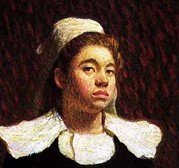
Roderic O'Conor
Irish Post-Impressionist-Style Painter:
Biography, Paintings.


|
Roderic O'Conor |
|
|
Roderic O'Conor (1860–1940)A Francophile, an exponent of Post-Impressionism, and one of the most famous figures in Irish painting of the late 19th and early 20th century, Roderic O'Conor was born in County Roscommon and entered the Dublin School of Art (now the National College of Art and Design) at the age of 19. The following year, along with fellow artist Richard Moynan, he studied drawing and fine art painting at the Royal Hibernian Academy, before going to the Academie Royale des Beaux Arts in Antwerp. After Antwerp, O'Conor spent time in Paris where he became inspired by the outdoor Impressionist painters like Pissarro and Sisley. As a result, he developed an interest in landscape painting and duly left Paris for the Breton village of Pont-Aven (a latter day Barbizon school), where he worked alongside several artists including the Post-Impressionist painters like Paul Gauguin. In some of his 1890s paintings one can see clear traces of the painting techniques which later became known as Fauvism and Expressionism. |
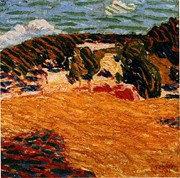 Field of Corn, Pont Aven Roderic O'Conor remains one of the most collectable artists. For more about the value of his works, compared to other record-breaking Irish artists, see: Most Expensive Irish Art. |
|
|
At the Pont-Aven school, O'Conor painted two portraits of Breton girls. And in his painting Field of Corn, Pont Aven (1892) his brushwork and colouring is reminiscent of the post-Impressionist Dutch painter Vincent Van Gogh, who had just committed suicide. O'Conor spent more of his life in France than any other Irish painter and unquestionably belongs to the sunny 'Post-Impressionist' world of the turn of the century. Inspired and engaged by the use of colour, his bold colors and color combinations give his work the stamp of true individuality. Other members of "The Antwerp School", like Walter Osborne and Nathaniel Hill (both more mainstream Impressionists) and Joseph Kavanagh (Dutch/Belgian style) tended to shy away from O'Conor's colourism. After 1904, O'Conor stayed in Paris for the next eight years. Soon his oil painting developed a rich vibrancy of color and a weight of impasto which became two of his mature hallmarks. His subject matter also changed. Instead of landscapes and outdoor artwork, he switched more to painted interiors, nudes and still-life painting. In Reclining Nude Before A Mirror (c. 1909), the subject is portrayed in a harmony of soft reds, pinks and violets under dim studio light and is reflected in a mirror, in the Baroque tradition. Other female nudes by O'Conor include: Reclining Nude (1910), Perles Rouges (1915), Reclining Nude on a Chaise Longue (1915), La Femme Au Drap Rouge (1916), Seated Nude, Half Length (1923). He died in Nueil-sur-Layon, France in March 1940. Most Expensive Painting By Roderic O'Conor The auction record for a work by Roderic O'Conor was set in 2005, when his oil painting, entitled La Lisiere Du Bois, was sold at Sotheby's, in London, for £792,000. See also: Plein-Air Painting in Ireland. |
|
More Information About Irish Visual Arts and Culture • For details of other Impressionists
and Post-Impressionists, see: Irish Artists:
Paintings and Biographies.
ENCYCLOPEDIA OF VISUAL ARTISTS IN IRELAND |