Joseph Malachy Kavanagh
Biography of Irish Landscape Artist &
Genre Painter.


|
Joseph Malachy Kavanagh |
|
IRISH PAINTING |
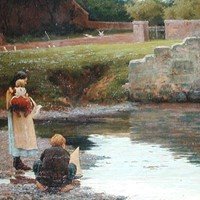
Joseph M Kavanagh RHA (1856-1918)Biography An important contributor to Irish painting, Joseph Malachy Kavanagh was born in Dublin, where his early artistic efforts were rewarded at the age of 12, when one of his pictures was accepted for the prestigious annual show of the Royal Hibernian Academy, and when (in the same year) he gained the silver medal in the Royal Dublin Society Christmas Competition. From 1877-8 he enrolled in the Metropolitan School of Art as a free student, studying alongside other great Irish artists such as Nathaniel Hill (1861-1934), Walter Osborne (1859-1903) and Roderic O'Conor (1860-1940). In 1881, his composition featuring Medieval monks won the Albert Scholarship, after which he, Hill and Osborne travelled to the Academie Royale in Antwerp for the "Nature" course under Verlat. The following year they returned to take Verlat's "Life" class in figure drawing. Afterwards, the three devoted themselves to landscape painting in Brittany and Normandy. |
|
|
|
|
Although he stayed in France until 1887, Kavanagh continued to contribute works to the RHA, and on occasion to the Royal Academy in London. Most of his Continental works consisted of rural and city genre paintings produced in Antwerp, Bruges, Mont St Michel, Quimperle, Dinan and Pont-Aven. One of his masterpieces of naturalism from this period is The Old Convent Gate, Dinan (1883), now in the National Gallery of Ireland. Unlike most other Irish landscape painters of "The Antwerp School", Kavanagh also developed an interest in etching, using this medium to produce numerous etchings of landscapes and architectural views. However, in comparison with Nathaniel Hill and Walter Osborne, Kavanagh was far less influenced by Impressionism, and showed little enthusiasm for plein-air painting. Instead, he was more affected by the Barbizon style landscape painting of the Dutch painter Anton Mauve (1838-88), a leading member of the Neo-Romanticist Hague School, and by rural realists like Jean-Francois Millet (1814-75). |
|
In 1887, he returned to Dublin, settling in Clontarf where he concentrated on unpretentious local subjects - beaches, dunes, watercourses and coastal views - including numerous landscapes and seascapes of Howth, Dublin Bay and the sands of Sutton, Portmarnock, Merrion and the North Bull - another of his noted works being Cockle-Pickers on the North Bull Sands (1893). He was also drawn to marshes and riverbank scenes, especially those around Portmarnock Marsh and Killester Ponds. Meantime, in 1889, he was elected an Associate Member and in 1891 a full Academician of the Royal Hibernian Academy, where he continued to exhibit on a regular basis and also joined the teaching staff. In 1910, after he had moved to Blackrock, he was appointed Keeper of the RHA and took up residence in their premises in Lower Abbey Street. In 1916, he was present in the RHA building when it was set ablaze by exploding shells. The resulting inferno destroyed most of the RHA paintings, as well as Kavanagh's own studio. Although he was fortunate enough to escape with minor physical injuries, all his unsold paintings had been destroyed in the fire - a blow from which he never recovered. He moved into Moran's Hotel, and died two years later. Rare surviving examples of Joseph Malachy Kavanagh's paintings and drawings are represented in the collections of the National Gallery of Ireland in Dublin, the Crawford Municipal Art Gallery in Cork, the Limerick City Gallery of Art, the Ulster Museum. Auction Record For Joseph Malachy Kavanagh The highest price paid at auction for a work by Joseph Malachy Kavanagh was recorded in 1995, when his genre painting, entitled Cockle Pickers on the North Bull Sands, was sold at James Adams, in Dublin, for IR£32,000. |
|
More Information • For a survey of genre artists, see:
Irish Genre Painters.
ENCYCLOPEDIA OF VISUAL ARTISTS IN IRELAND |