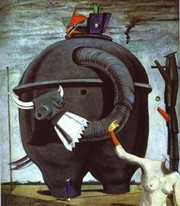
Max Ernst
Biography, Paintings of Dada/Surrealist Artist.


The Elephant Celebes (1921)
Tate Collection, London.

MODERN ARTISTS
For a list of painters like
Max Ernst, see:
Modern Artists.

Max Ernst (1891-1976)

The avant-garde German painter, sculptor, graphic artist and poet Max Ernst, was - with his lifelong friend Jean Arp (1886-1966) - the co-founder of the Cologne branch of Dada, and later became an important member of the Surrealism movement. He never received any formal training in painting or sculpture, and when he turned to art he sought to represent the fairy-tale creatures of his childhood on canvas. A prolific and highly experimental artist, Ernst developed several new painting techniques: frottage (rubbing textured surfaces), grattage (frottage applied to painting), and decalcomania (liquid paint patterns), which resulted in many unique Surrealist works. Some of his most famous pictures include: The Elephant Celebes (1921, Tate Gallery); Ube Imperator (1923, Pompidou Centre, Paris); Grattage: Eclipse of the Sun (1926, private collection); The Entire City (1935, Kunsthaus Zurich); Attirement of the Bride (1940, Guggenheim, Venice); and Old Man River (1953, Kunstmuseum Basel). A leading figure in modern art of the early 20th century, Ernst influenced an entire generation of contemporary Surrealists artists including Salvador Dali (1904-89) and Yves Tanguy (1900-55).

COLOURS USED IN PAINTING
For an idea of the pigments
used by Max Ernst, see:
Colour Palette Nineteenth Century

WORLDS TOP ARTISTS
For top creative practitioners, see:
Best Artists of All Time.
For the greatest view painters, see:
Best Landcape Artists.

WORLD'S BEST ART
For a list of the best examples of
Fine Art Painting, by the
world's top artists, see below:
Greatest Modern Paintings
Oils, watercolours, mixed
media from 1850-present.
Oil Painting
History, styles and development.

WHAT IS ART?
For an explanation of the
aesthetic issues surrounding
the creative visual arts, see:
Art Definition, Meaning

Early Career

Ernst was born near Cologne in 1891. His father was a teacher, and a part-time painter of some repute. In 1909 Ernst enrolled at Bonn University to study philosophy and art history while painting in the evenings in the style of Van Gogh. After 12 months he decided to devote himself entirely to art, and left his studies. He never received any formal art education, preferring to devote himself to copying the painting and drawing techniques of the Old Masters. In 1911 he joined Das Junge Rheinland, a group of liberal minded painters including August Macke, an early pioneer of German Expressionism. Through Macke, Ernst was introduced to the Blue Rider group in Munich, and in 1913 he exhibited alongside Kandinsky, Klee, Chagall, Delaunay and Macke in the Sturm Gallery. At this point in his career, Ernst’s paintings showed clear influences of the Blue Rider, as well as Futurism. His subject matter is fantastical, dream-like and whimsical.


Dadaism

At the start of World War I, Ernst met the artist Jean Arp: their friendship would last a lifetime. Initially drafted into the war effort, Ernst was still able to paint, and was introduced by Arp to Dadaism. In 1916 Arp became one of the founding members of the Dada movement in Zurich. Outraged by the carnage and immorality of the War, Dadaists were anti-war, anti-art, and determined to ridicule what they considered to be the meaninglessness of the modern world. It was, to a great extent, anarchistic in nature. In 1920 Arp, Ernst and a left wing activist and painter Alfred Emanuel Ferdinand Gruenwald set up the Cologne branch of Dada. In 1919 Ernst published Fiat Modes - 8 lithographs which, with their bizarrely stuffed dummies and impossible perspective systems, displayed influences of the Italian Surrealist Giorgio de Chirico. Working in various mediums including oil on canvas, gouache on paper, pen and ink drawings and collage, Ernst, along with Helmut Herzfelde (aka John Heartfield), created numerous satirical collages, using popular printed material, depicting the grotesque and the erotic, in a style which heralded Parisian Surrealism. Examples from this period include: Family Excursions (c.1919, Narodni Gallery, Prague); The Small Fistule That Says Tic Tac (1920, The Museum of Modern Art, New York); and Birds, Fish-Snake and Scarecrow (c.1921, Staatsgalerie Moderner Kunst, Munich).


Surrealism

The move to Surrealism was a natural one - Ernst was attracted to the dream-hypnosis, and he found inspiration in the works of de Chirico's Metaphysical paintings. In 1925 Ernst's work appeared in the first exhibition of the Surrealist group at the Galerie Pierre in Paris. Andre Breton, the leading theorist of the Surrealist Group, asserted that Surrealism was a revolutionary movement. Borrowing liberally from Dadaism, Surrealism eventually spread around the world and affected not only visual arts, but literature, poetry, music, philosophy and social theory. Other proponents included Salvador Dali, Enrico Donati, Rene Magritte, Valentine Hugo, Meret Oppenheim, Luis Bunuel, and Alberto Giacometti.

Frottage Technique

In the early 1920s Ernst developed a technique called frottage (rubbing) - which involved placing objects under a canvas layered in paint, and then scraping back the paint on the raised areas of the canvas. This technique is used in one of his most popular paintings Forest and Dove (Tate Modern). In contrast to the concise brushstroke of his earlier works, these canvases are spontaneous and full of movement. They are expressionist forms of horses, birds, forests, flowers which hint at an underlying violence and passion that Surrealists believed was fundamental to human nature. In 1926, Ernst collaborated with Joan Miro in creating designs for Sergei Diaghilev's Ballets Russes, and also explored Decalcomania, a technique which involves pressing paint between two surfaces.

During the 1930s the imagery of Ernst's works became more menacing, and depicted monsters and skeletal cities. He was becoming increasingly worried about the political situation in Europe. He returned to traditional oil painting techniques for a period, examples include Garden Airplane-Trap (1935, Pompidou Centre, Paris) and The Angel of Hearth and Home (1937, private collection). Also during the 1930s he created an entire series of cityscapes and landscapes, using a variety of media including oils and frottage.In 1938, the wealthy art collector, Peggy Guggenheim bought several of Ernst's paintings, which she displayed in her new museum in London.

Collage Novels

In 1929 Ernst published the first of his collage-novels, La Femme 100 Tetes. The title is a pun in French, which could read the Woman with 100 heads, or alternatively the Woman without a head. In this, and other novels, including A week of Goodness (1934), Ernst altered 19th century engravings through the collage process, creating some of his most original contributions to art.

Mature Career

On the outbreak of World War II, Ernst was interned by the French as an enemy alien. During this time, his mistress, the English painter Leonora Carrington, fled to Spain where she suffered a nervous breakdown. Luckily, in 1941, with the help of Peggy Guggenheim, Ernst escaped to New York where they were married the following year. New York had become a magnet for many of Europe's leading artists, and there, along with Marcel Duchamp and Marc Chagall who had also escaped, Ernst edited the Surrealist review VVV.

War Years

During the war years, his paintings became increasingly rich in colour and more detailed. He used the Decalcomania technique (which had actually been invented by the Surrealist painter Oscar Dominguez) to greater effect. He shook runny paint over the canvas and then put a sheet of glass over it, creating surrealist, dreamlike shapes. He created impressions of seabeds, coral reefs, rotting vegetation – exemplified by his unusual and apocalyptic work Europe after the Rain II (1940, Wadsworth Atheneum, Hartford). In addition, he also experimented with a crude method of "action-painting" (popularized by Jackson Pollock), in which he dripped paint onto a canvas from a swinging can with holes in the sides. Interestingly, his wife - the art collector and dealer Peggy Guggenheim - became a major buyer of Jackson Pollock's paintings.

Ernst also began to work with sculpture, creating bronze casts. Sadly his marriage to Guggenheim did not last long, and in 1946 he married the American artist Dorothea Tanning, in a double wedding ceremony with Man Ray and Juliet Browner.

By this stage, Ernst was well established and financially secure. In 1948 he published his treatise, Beyond Painting. In 1953 the couple moved to France, and in 1954 he won the main painting prize at the Venice Biennale, which ushered in a period of esteemed old age. He became a French citizen in 1958. Artistically, his post-war work is varied in style and technique, and becomes increasingly bright. Now represented in many of the best art museums around the world, Ernst had the most impact on Surrealist artists who evolved after the mid 1920s, including Salvador Dali. His cultured intelligence contributed to the development and range of the Surrealist movement and philosophical thinking. He also influenced the development of Abstract Expressionism. Ernst died in 1976.

• For more biographies, see: Famous Painters.
• For details of major art periods/movements, see: History of Art.
• For a chronological list of important dates, see: Timeline: History of Art.
• For biographies of sculptors and painters from Ireland, see: Famous Irish Artists.
• For more information about modern art, see: Art Encyclopedia.

• To update this online biography of the Dada and Surrealist painter Max Ernst, click here.


Art Movements | Art Glossary | Art Questions | Sitemap: International Art
ENCYCLOPEDIA OF ART
© visual-arts-cork.com. All rights reserved.