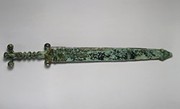
Celtic Weapons Art
Swords, Scabbards, Shields, Helmets,
Decorated Phalerae.



|
Celtic Weapons Art
|
|
CELTIC CULTURES |
Celtic Weapons ArtContents • Swords |
| CELTIC
ARTISTRY The Celts were successful traders and used their control of waterways like the River Danube to acquire expertise in the iron trade, from which sprang their unique mastery of blacksmithery and metalwork. In particular it was their skill in the forge and in their use of chisels, hammers and other tools (essential in the design and manufacture of weaponry), that led to the Celts' reputation as master craftsmen and metallurgical artists. In their decoration and ornamentation of their swords, scabbards, shields, and helmets, Celtic metalworkers were greatly influenced by artists from the Black Sea, Etruria and Ancient Greece. |
|
ART OF THE ANCIENT
CELTS |
Most early commentators noted that the Celts had an unusual manner of fighting. Their chief weapon was a heavy, long-bladed sword, which they wielded with devastating efficiency. This type of weapon seems to have been developed to counteract the phalanx, the robust military formation that was favoured by the Greeks and other Mediterranean armies. Celtic warriors attempted to breach this solid mass of soldiers by making a ferocious frontal assault. Powerful weapons were essential if this kind of approach was to succeed and, judging by the rapid progress made during the period of Celtic expansion in the 4th century B.C., the tactic was effective for a time. Nonetheless, there were drawbacks. The initial onslaught often resulted in high casualties and, if it failed, the impctus of the attack could peter out very quickly. |
|
CHRISTIAN CELTIC-STYLE
ART ART/ARCHITECTURE
IN IRELAND EVOLUTION OF THE
ARTS
|
Many ancient sources confirm this, reporting
how the Celts could become totally disheartened, if they did not achieve
an immediate breakthrough. In addition, the weight of the sword made it
cumbersome to use, which proved a great disadvantage in hand-to-hand fighting. By and large, scabbards offered greater scope for decoration and the range of options was considerable. The best-known individual example is the proto-Celtic scabbard from grave 994 at Hallstatt. The images on this - soldiers, horsemen, and figures turning a wheel - have a narrative quality that is unusual in Celtic art. The stylized dragons at the chape (or point), however, are much more typical. In true Celtic fashion, they almost seem to slither up the edge of the scabbard. |
| DESIGNS
OF THE CELTS For the history & development of Celtic Designs, in particular the iconography, zoomorphs and decorative art motifs employed by the ancient Celts, in metalwork, ceramics and other artworks please see: Celtic Interlace Designs Celtic Knots Designs Celtic Crosses Designs Celtic Spirals Designs |
|
|
Plant forms and stylized animals proved
to be the most popular motifs throughout the La Tene era. During the Waldalgesheim
period, in particular, craftsmen demonstrated a preference for flowing
tendril patterns, running the full length of the scabbard. These were
usually created with the aid of compasses. The tendril designs were often
enlivened with faint hints of animal forms. On a French scabbard discovered
at Cernon-sur-Coole, eagle-eyed observers can discern a series of rudimentary
bird heads. These consist of nothing more than a slit-like eye and a rapacious
beak, which curves round sharply, merging with the line of the tendril. Archaeologists have come across two distinct
classes of arms and armour at Celtic sites. There are the functional items,
often bearing the scars of battle, which were interred in warriors' graves.
In addition, there are much more attractive articles, lavishly decorated
and clearly never intended for practical use. These ceremonial pieces
were placed in the graves of chieftains or other figures of exalted rank.
Alternatively, they were donated to the gods as a form of sacrifice. Many
of these items have been retrieved from rivers and lakes, where they were
deliberately discarded. From an archaeological point of view, the advantage
of this practice is that the artifacts have often survived in remarkably
good condition. This is in marked contrast to the process of ritual damage,
where objects were bent or broken prior to the sacrifice. The shields used by Celtic warriors were
quite different from their Mediterranean counterparts. The latter were
normally round or curved, whilst the Celts preferred to use long, flat
shields with a protruding central section. This could either take the
form of a circular boss or a slender, rib-shaped umbo. The purpose of
the cavity was to provide the warrior with a more comfortable handgrip
which, in turn, offered greater manoeuvrability. The drawback, however,
was that the boss could endanger the wearer. In early La Tene models,
it was only held in place by two nails, which could be pushed dangerously
close to the warrior's hand, if the protrusion was struck with any force.
In time, this led to the enlargement of the boss, so that the nails could
be located further away from the hand or, alternatively, to the creation
of a combined boss and rib cavity. The most elaborate designs exploited the
combination of the mid-rib and the boss. This is illustrated most persuasively
on two British shields, which were dredged out of the River Witham and
the River Thames. In both cases, the ends of the rib have been enlarged
to form two extra bosses. These are purely ornamental, serving no practical
purpose. On the Witham shield, the bosses were created with a mixture
of delicate repousse work and engraving. This was at its finest on the
edges of the outer roundels, where the artist conjured up a subtle evocation
of two long-snouted beasts, in the ambiguous manner which the Celts admired
so much. The Witham shield has also attracted attention for another reason.
Tiny rivet holes indicate that it once bore an entirely different design,
which was removed by a later owner. The original pattern was a primitive
representation of a boar with spindly, stilt-like legs. This was apt,
since the boar was a conventional war symbol, but it is equally clear
why the new owner replaced it with the sinuous elegance of the current
design. The change is also interesting, because it confirms that Celtic
warlords liked to personalize their equipment, just as the knights of
a later age would do through the medium of heraldry. There is no doubt that the Battersea shield was conceived purely as a luxury item. Originally, it was gilded and, almost certainly, it was deposited in the Thames as a votive offering. This trend was echoed in the production of helmets, where the use of precious materials and showy designs was even more widespread. The most lavish Celtic helmets were those created in the 'jockey-cap' format. These were inspired by Etruscan or Italian models and date back to around the 4th century BCE. In most cases, thcy consist of a hemispherical cap, a hinged cheek-flap, a neck-guard, and a fitting at the top for a plume or crest. Bands of decoration cover the entire surface, which may also be studded with pieces of coral or coloured glass. The most spectacular example is the Agris
helmet, which was discovered in a grotto near Angouleme in 1981. The
crown itself is iron, but the attachments are made of bronze, covered
in gold leaf, and the rivets are silver. The bands of dccoration have
a transitional flavour, blending elements from the Early and Waldalgesheim
Styles. Geometric patterns nestle alongside running palmette and lotus
motifs. The sinuous decoration on the one surviving cheek-piece is particularly
interesting, as it appears to represent a horned serpent. This was a conventional
chthonian symbol, which implies that the grotto may have been revered
as an entrance to the Celtic Otherworld. Another notable jockey-cap helmet was discovered
in 1895, in a tomb complex at Canosa di Puglia. Despite its Italian
location, this, too, was probably made in Gaul and perhaps belonged to
a Celtic mercenary. In this case, there is no gold leaf at all. Instead,
the openwork design of lyres and S-curves is set with pieces of coral.
Comparisons have often been drawn between this and the painted decoration
on the Prunay vase, which dates from the same period. Celtic War
Trumpets Celtic Horse Fittings and Equipment Horses and chariots played an integral
role in the martial activities of the Celts. Accordingly, warrior chieftains
took pains to deck them out with the kind of finery that would set off
their own ceremonial gear. Horse-bits, harness mounts and terrets (chariot
rings) were all adorned with the full repertoire of Celtic motifs. Many
examples of these have been found in the cart or chariot burials, which
date back as far as the Hallstatt period. In these, persons of high rank
were interred along with the vehicle. In most cases, the chariot was dismantled
and, on rare occasions, the owner's horses were sacrificed and placed
inside the grave. The items found at the chariot grave of
Mezek in Bulgaria, could hardly be more different. These include
a range of yoke mounts, terrets and linchpins, which are prime examples
of the Plastic Style. Knobbed protruberances jut out at every angle, hinting
at swollen-cheeked faces and bulging eyes. |
|
• For more about the history of Irish
culture, see: Visual Arts in Ireland.
ENCYCLOPEDIA OF IRISH AND CELTIC ART |